
Geometric Audio Merge
Angela Bulloch

Angela Bulloch
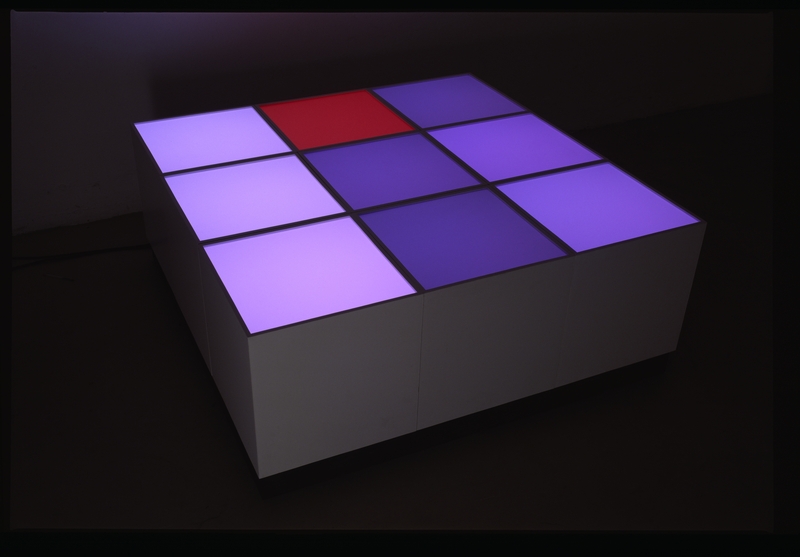
Geometric Audio Merge, 2002
Installation with nine plastic DMX pixel modules in plinth, RGB lighting system, DMX controller, speakers, soundtrack 4 min 32 sec (animation, sound)
Overall dimensions variable
Thyssen-Bornemisza Art Contemporary Collection
Photo: Carsten Eisfeld
- Date
- 2002
- Medium
- Installation with nine plastic DMX pixel modules in plinth, RGB lighting system, DMX controller, speakers, soundtrack
- Dimension
- 60 x 150 x 150 cm (plinth with pixel modules) 4 min 32 sec (animation, sound) Overall dimensions variable
- Credit
TBA21 Thyssen-Bornemisza Art Contemporary Collection
- This artwork is part of the donation and long-term loan from TBA21 to the Museo Nacional Thyssen-Bornemisza.
Details
Angela Bulloch’s work has centred on a modular type of light box she developed and patented with the German artist Holger Friese. Physically, the light boxes are the last word in minimalist chic: each is a 50 cm cube in birch, except for one side that is milky perspex. Beneath the simple exterior lie red, blue and green fluorescent lights capable of mixing 16 million colours, most of which the human eye cannot discern. Each light box acts as a single, extremely large pixel which can respond to a range of information.
Through one configuration of thirty-two boxes Bulloch played scenes of catastrophies from Stanley Kubrick’s "2001: A Space Odyssey" and Michelangelo Antonioni’s "Zabriske Point". The stacked boxes resembled the size and dimensions of an average cinema screen, and yet the photographic imagery was reduced to just thirty-two squares of coloured light. Although it was impossible to make anything out, something of the atmosphere of each film was conveyed through the precisely modulated colours. If this vertical formation alluded to cinema on the one hand and geometric abstract painting on the other, then Bulloch’s Geometric Audio Merge, a horizontal formation, conflates a 70s disco floor with a Carl Andre floor sculpture.
Here, audio information – "Good Times" by Chic overlaid with some live sound samples of the artist playing the base – is translated into colour sequences infinitely more complex than those John Travolta danced on in "Saturday Night Fever". On one level, the piece might be interpreted as a pop cultural re-working of the way early modernist artists invoked music in defense of abstraction in painting.
Alex Farquharson

