
Algunas Calles y Otros Cuerpos
Jacobo Castellano
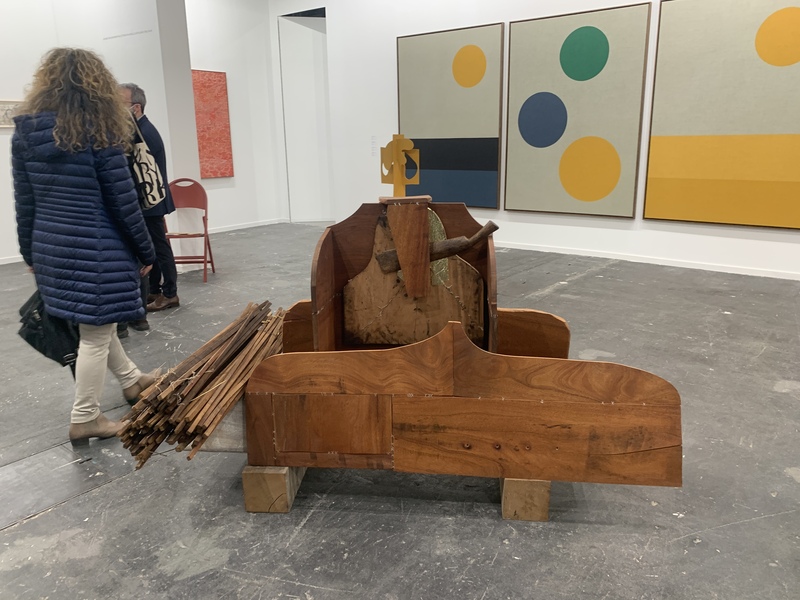
- Date
- 2022
- Medium
- Pine, sapelly, iroko, alpaca, soft brass, hard brass, staples, thermal blanket, ink, linen, oil and wax
- Dimension
- 109 x 192 x 136 cm Overall dimensions variable
- Credit
TBA21 Thyssen-Bornemisza Art Contemporary Collection
- This artwork is part of the donation and long-term loan from TBA21 to the Museo Nacional Thyssen-Bornemisza.
Details
Working with wood and carefully selected found objects, Jacobo Castellano (b.1976 Jaén, Spain) makes use of his own personal history, as well as Spanish tradition and religion as the main source of inspiration for his sculptures that convey a narrative constructed through the assemblage of disparate objects.
Memory, fragmentary and abject, specifically memories from childhood, play a large role in Castellano’s work. In a previous exhibition, titled riflepistolacañón, Castellano made use of a child’s drawing, found on the street, which depicted different weapons — a rifle, a pistol, a cannon — as the starting point for the exhibition. Showing the child’s drawing at the beginning of the show, Castellano drew attention to the link between the playful and the violent, a recurring theme and one which demonstrates how the artist perceives the world. The title itself spits at the viewer, no grammar is present, like a memory it jolts the mind and comes without necessary reason. Castellano has also made a motif of the ‘torno’ in his recent work — a revolving door or window found in Spanish and Latin American cloistered convents used to transfer goods and people that can be seen as a threshold between the hidden and public, the holy and secular realms.
In Algunas Calles y Otros Cuerpos (Some Streets and Other Bodies), Castellano brings together many of the features of his previous work. An amalgam of many materials, the sculpture is however cohesive in its presentation, echoing the way in which the former lives of all of these materials are being melded into one new and concise vision — a new memory. The title could suggest the marrying of the architectural, rigid, seemingly not alive buildings and concrete of a modern city and the moving, living bodies of the people and animals that live within its walls. Castellano perhaps suggests that these two things are inseparable from one another, both need each other to fulfil their role and to exist to their fullest potential, much like the disparate materials he has assembled need one another in order to translate their individual and collective stories to the viewer.
Castellano recontextualises the history of his found objects and the fragments of his memory, offering something for the viewer to impose their own personal story on to.