
Huertos de los Ch’olti
Naufus Ramírez-Figueroa
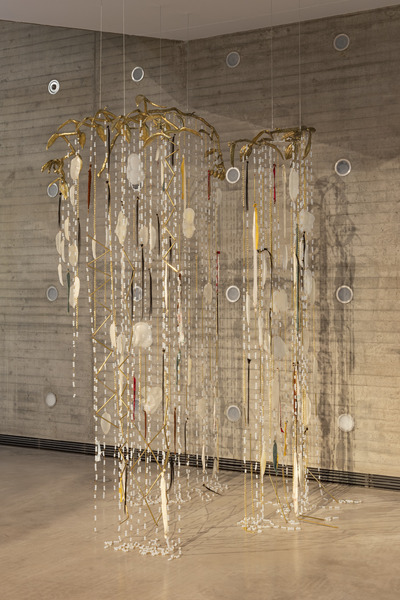
- Date
- 2020
- Medium
- Installation with three beaded curtains (bronze, ceramic beads, resin, glass, artificial hair, textile)
- Dimension
- Overall dimensions ca. 270 x 120 x 45 cm
- Credit
Commissioned and produced by TBA21 Thyssen-Bornemisza Art Contemporary for How to Tread Lightly
TBA21 Thyssen-Bornemisza Art Contemporary Collection- This artwork is part of the donation and long-term loan from TBA21 to the Museo Nacional Thyssen-Bornemisza.
Details
Taking inspiration from the “enchanted” gardens of the former Ch’olti-speaking territory in today’s Belize and Guatemala, Huertos de los Ch’olti (Orchards of the Ch’olti) consists of a series of beaded curtains, each hanging from a branch, made of bronze and adorned with cacao, vanilla, and achiote fruits. These three cultigens were at the center of a complex pre-Hispanic agro-economic system among the Manche Ch’ol of the Maya Lowlands until the end of the seventeenth century. In 1695, when the Spanish colonialists overran the territories, the Friar Francisco Morán recorded the Ch’olti language in a manuscript named Arte y vocabulario de la lengua Cholti. It is the only document to evidence the Ch’olti language before its extinction. After years of unsuccessful pacification and following Morán recommendations, the Ch’olti-speaking people were violently displaced and annihilated and their homeland depopulated by the military and missionary powers. For decades to come, the Manche Ch’ol territory remained an enchanted and haunted place for the colonists. Morán’s manuscript and the context in which it was created reflect the long history of religious imperialism and evangelism in Latin America, processes of deculturization, and loss that Guatemalan people still suffer today.
A series of preparatory drawings for the installation channel a fragmented imagery, giving shape to the lost Manche Ch’ol people. Borrowing from the language of Indigenous cosmologies and science fiction, the drawings portray subjects that appear as ghosts, spirits, or Earth-beings: faces and bodies with human features that morph into plants, bulbs, blossoms, and leaves. Drawn on white paper or, at times, on a cloudy background painted in watercolors, these figures live in a state of transition, between one world and another. In Ramírez-Figueroa’s work, surreal worlds are haunted by ghosts both personal and collective.
(Text written by TBA21 and used as wall label in the exhibition "Abundant Futures", C3A, Córdoba, 2022)


